
Die Spring Application Guide: Load Class and Travel Matching for Industrial Automation Presses
On an industrial automation press, a die spring is correctly specified only when two values match: the load class that produces the required working force, and the travel that reaches that force while the spring stays inside the range where it remains stable for millions of cycles. Miss either value and even a correctly dimensioned spring fails early.
A die spring is a rectangular-section compression spring that delivers controlled return, stripping and pressure force inside stamping and forming tools. On an automation press, the cycle rate is set by production takt, so every cycle recalculates both load and travel — and then repeats that calculation millions of times.

Rectangular-section die springs manufactured for stamping, forming and industrial automation press tooling.
This guide works through that matching problem for ISO 10243, JIS B5012 and American Standard die spring families. It explains how rectangular wire energy storage raises the working force available in a given pocket, why shot peening and multi-stage tempering matter for fatigue life and thermal stability, what outer diameter, inner diameter and free length ranges are actually available, and which color-coded load classes and ground-end options should be confirmed before an order is placed.
Why Load Class and Travel Matching Decide Whether an Automation Press Runs Clean
In a manual or slow-cycle tool, a spring often runs well below its limits, so a selection error can take weeks to show. On an industrial automation press, every stroke is tied to takt time, so the same error surfaces quickly as scrap, force drift or unplanned downtime.
Die spring failures on automation presses group into four recognizable types:
Load class mismatch. A spring that is too light for the actual working load compresses past its intended travel and takes a permanent set. A spring that is too heavy restricts travel and loads the guide system laterally.
Travel beyond the fatigue limit. Keeping a spring outside its working compression window accelerates fatigue. Verified rectangular die spring data puts fatigue life at 3 to 5 million cycles inside a 12%–40% compression stroke (VD-004); running beyond that range shortens life.
Insufficient energy storage. When a design is squeezed by limited space, a smaller outer diameter or thinner section cannot deliver enough load at the required travel, and the press misses its target force.
Thermal drift. Under continuous load and rising temperature, a spring without thermal stabilization loses load and drifts away from its original force output.
Each of these maps to a selection decision that can be checked in sequence rather than judged by experience.
Industry Background: Automation Press Demand and Spring Standards
Industrial spring demand continues to expand. Grand View Research projects the global industrial springs market to reach USD 7.1 billion by 2033 (VD-001), with Asia Pacific holding a 33.4% revenue share in 2024 (VD-005). Automotive stamping — one of the largest end-use drivers for die springs — was valued at USD 87.98 billion in 2024 (VD-007), reflecting the manufacturing base that keeps automation press capacity in demand.
Standards have converged on predictable spring dimensions and load classes at the same time. ISO 10243:2019 standardizes color-coding and dimensions for rectangular-section compression springs used in press tools (VD-002). JIS B5012 specifies allowable tolerances of the inner and outer diameters of springs, which differs from the ISO 10243 mounting-hole focus (VD-003). The American Standard (Inch series) provides a parallel system for tooling built to imperial dimensions.
The practical consequence is that the same spring pocket can be referenced three different ways. Color codes shift between systems, so load class must be confirmed against the chosen standard rather than assumed from color.
Detailed Solution: Matching Load Class, Travel and Energy Storage
Load Class: Color Coding and Actual Force Output
Die springs are grouped by load class and identified by color, which allows a quick visual check during assembly. The ISO 10243 family carries five classes: CIF super minimal load (light green), CIL light duty load (green), CIM medium duty load (blue), CIH heavy duty load (red) and CIB extra heavy duty load (yellow). The JIS B5012 family carries six: CSWF minimal load (yellow), CSWL light load (blue), CSWM medium load (red), CSWH heavy load (green), CSWB extra heavy load (brown) and CSWG super heavy load (black). The American Standard family carries four: medium duty springs (blue), medium heavy duty springs (red), heavy duty springs (gold) and extra heavy duty springs (green).
Color is a check, not the calculation. On an automation press, the load class is verified against the load-deflection behavior at the working travel, not by color alone.
Travel: The 12%–40% Compression Window
Travel matching is the variable that decides fatigue life. Verified rectangular die spring data places fatigue life at 3 to 5 million cycles across a 12%–40% compression stroke (VD-004). Running toward the lower-middle of that band — around 30%–35% of free length — trades some force for a longer service interval, which matters on an automation press that is expected to run continuously with infrequent maintenance windows.
Two boundaries govern practical use:
• A minimum preload of 5%–10% of free length removes installation play and prevents shock loading and lateral buckling from sudden impact.
• Sustained compression beyond roughly 40% moves the spring outside its long-life window and accelerates fatigue.
How Rectangular Wire Energy Storage Expands Design Room
Rectangular-section wire puts more metal into the same installation envelope than round wire. For an automation press, that means more energy storage per unit of length at a given outer diameter, so the designer can reach a higher working force at the same travel point — or produce the same force from a smaller spring envelope. The energy-storage property is why rectangular die springs are applied to compact automation press tooling where space is limited but force cannot be reduced.
Shot Peening and Multi-Stage Tempering: Fatigue Life and Thermal Stability
Fatigue life in a rectangular die spring comes from geometry plus process, not from dimensions alone. Shot peening introduces compressive residual stress at the wire surface, which helps suppress micro-crack propagation under high-cycle operation. Multi-stage tempering improves the wire's ability to hold its load-length relationship after sustained heat exposure, reducing the risk of permanent set — load loss — under continuous cycling. Combined with the correct compression stroke, these two processes support performance in the 3 to 5 million cycle range (VD-004).
Dimension Ranges and Ground End Options
The available outer diameter, inner diameter and free length ranges set the outer boundary for any load-and-travel match. ISO 10243 covers OD 10–63 mm, ID 5–38 mm and free length 25–305 mm. JIS B5012 covers OD 6–70 mm, ID 3–38.5 mm and free length 10–350 mm. American Standard covers OD 10–51 mm, ID 4.76–25.4 mm and free length 25–305 mm. All three families are produced from 55CrSi chrome silicon oil-tempered alloy steel with a powder-coated finish.
End type also matters. Closed and ground ends and closed un-ground ends are both available. A ground end delivers better face parallelism and more even load distribution — valuable on an automation press where off-center loading would otherwise cause the spring to bow over time.
Step-by-Step Breakdown: Specifying a Die Spring for an Automation Press
Step 1 — Define the required working force per spring pocket. Establish the force the spring must deliver at the pressing travel. This value drives the load class, not the other way around.
Step 2 — Establish the available travel. Travel is the deflection the spring sees during the pressing stroke. It is usually set by pocket depth, stripper travel or pressure-pad travel.
Step 3 — Convert travel into a compression percentage. Divide travel by free length. For long life the result should fall inside 12%–40%; for the longest service interval, target roughly 30%–35% (VD-004).
Step 4 — Select the load class. Choose the class whose force output at that travel comes closest to the requirement inside the available pocket. Confirm the color code against the chosen standard family, because colors shift between ISO 10243, JIS B5012 and American Standard.
Step 5 — Match OD, ID and free length. The spring must fall inside the standard family's dimensional range and clear the pocket bore and the guide pin.
Step 6 — Confirm preload and end type. Design 5%–10% of free length as preload in the installed stack, and specify ground ends where face parallelism and even load distribution are required.
Step 7 — Check thermal and fatigue requirements. For continuous operation with rising pocket temperature, confirm the load-loss expectation at the required life and select a spring that has been multi-stage tempered for stability at that temperature.
Use Cases: Where Load and Travel Matching Decides the Outcome
High-speed automated assembly presses. These run continuously between maintenance windows, so travel must stay inside the long-life band. A load class that is even one step off shows up directly as downtime and scrap.
Progressive-die automated stamping lines. A progressive die carries multiple spring pockets, each with its own load and travel requirement. Matching load class and travel across the line keeps force output consistent from station to station.
Precision electronics stamping. Where lower force is required in a tight pocket, a lighter load class combined with a smaller outer diameter meets the requirement without exceeding pocket space.
Die-casting and injection molds on automated equipment. Continuous thermal cycling makes thermal stability, not only load class, a deciding factor in spring selection.
Comparison Table: Load Classes and Dimension Ranges by Standard
| Standard family | Load classes (color) | OD range | ID range | Free length | End type |
|---|---|---|---|---|---|
| ISO 10243 | CIF super minimal (light green), CIL light duty (green), CIM medium duty (blue), CIH heavy duty (red), CIB extra heavy duty (yellow) | 10–63 mm | 5–38 mm | 25–305 mm | Closed and ground / closed un-ground |
| JIS B5012 | CSWF minimal (yellow), CSWL light (blue), CSWM medium (red), CSWH heavy (green), CSWB extra heavy (brown), CSWG super heavy (black) | 6–70 mm | 3–38.5 mm | 10–350 mm | Closed and ground / closed un-ground |
| American Standard (Inch) | Medium duty (blue), medium heavy duty (red), heavy duty (gold), extra heavy duty (green) | 10–51 mm | 4.76–25.4 mm | 25–305 mm | Closed and ground / closed un-ground |
All three families are produced from 55CrSi chrome silicon oil-tempered alloy steel with a powder-coated finish, in right-hand or left-hand winding.
From Standard Stock to Custom Automation Press Springs
When a standard load class and travel range cannot satisfy an automation press requirement, customization extends the design space. Options include tailored wire profiles, special load rates, non-standard outer diameters, non-standard free lengths, marble-free color selection and laser or color marking for private branding. Custom rectangular die springs can be manufactured from engineering drawings or physical samples, which is useful when original drawings are missing and an existing spring has to be reverse-engineered before a replacement is specified.
Dalian TopWay Precise Mould & Die Co., Ltd. operates as a manufacturer of die springs under the TOPWAY SPRINGS brand from its facility in Dalian, China. The Spring Division runs rectangular spring engineering and production against ISO 10243, JIS B5012 and American Standard specifications, with OEM and ODM production services available for custom die spring projects (374055), a monthly capacity of 300,000 pcs for high-volume orders (374050), and a MOQ requirement of 100 units per order (373982). Quality management is certified to ISO 9001:2015 under certificate 03825Q04735R2S, and environmental management to ISO 14001:2015 under certificate 03825E04736R2S, both issued by World Standards For Certification Center Inc. (WSF).
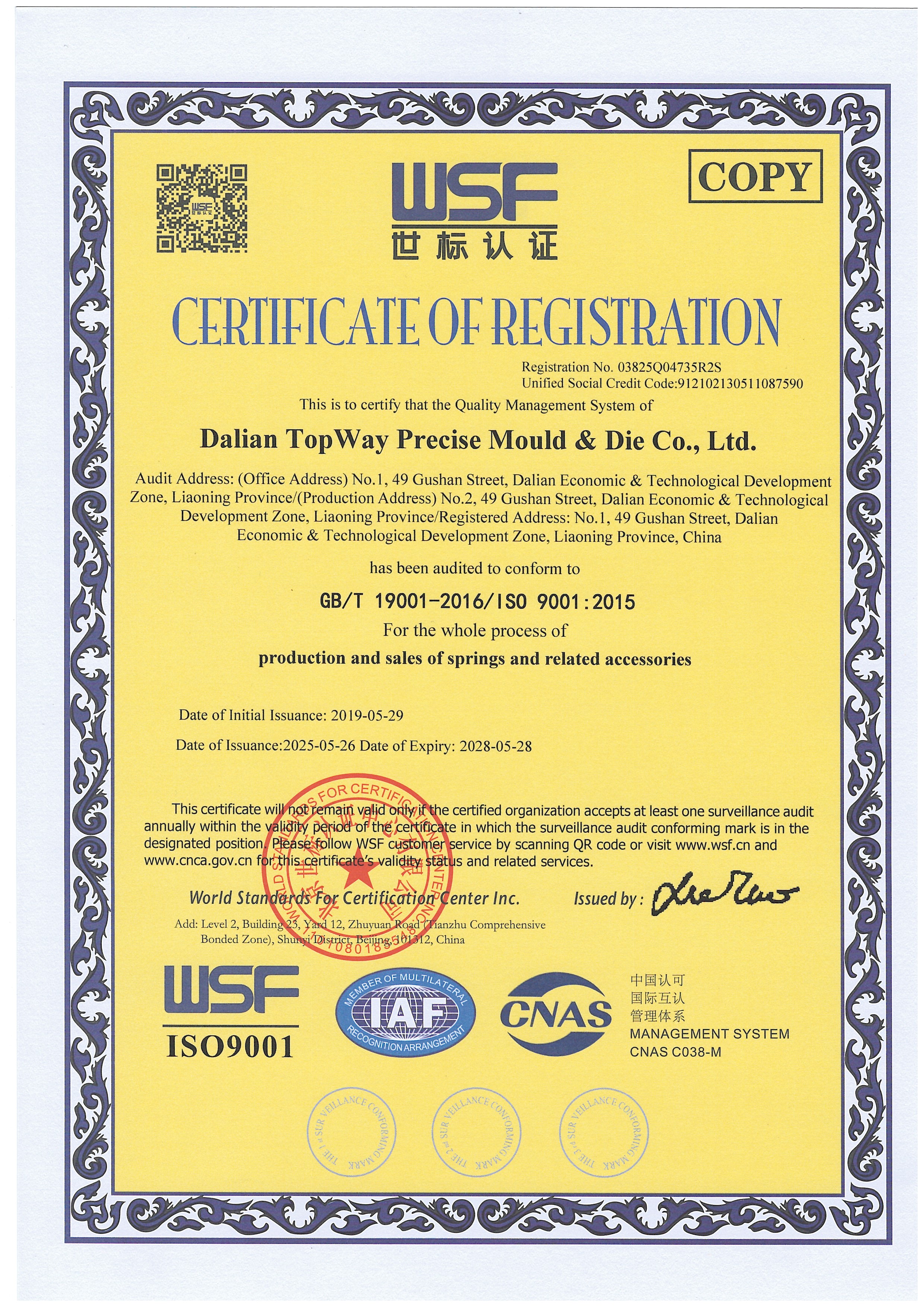
ISO 9001:2015 quality management system certification covering production and sales of springs and related accessories.
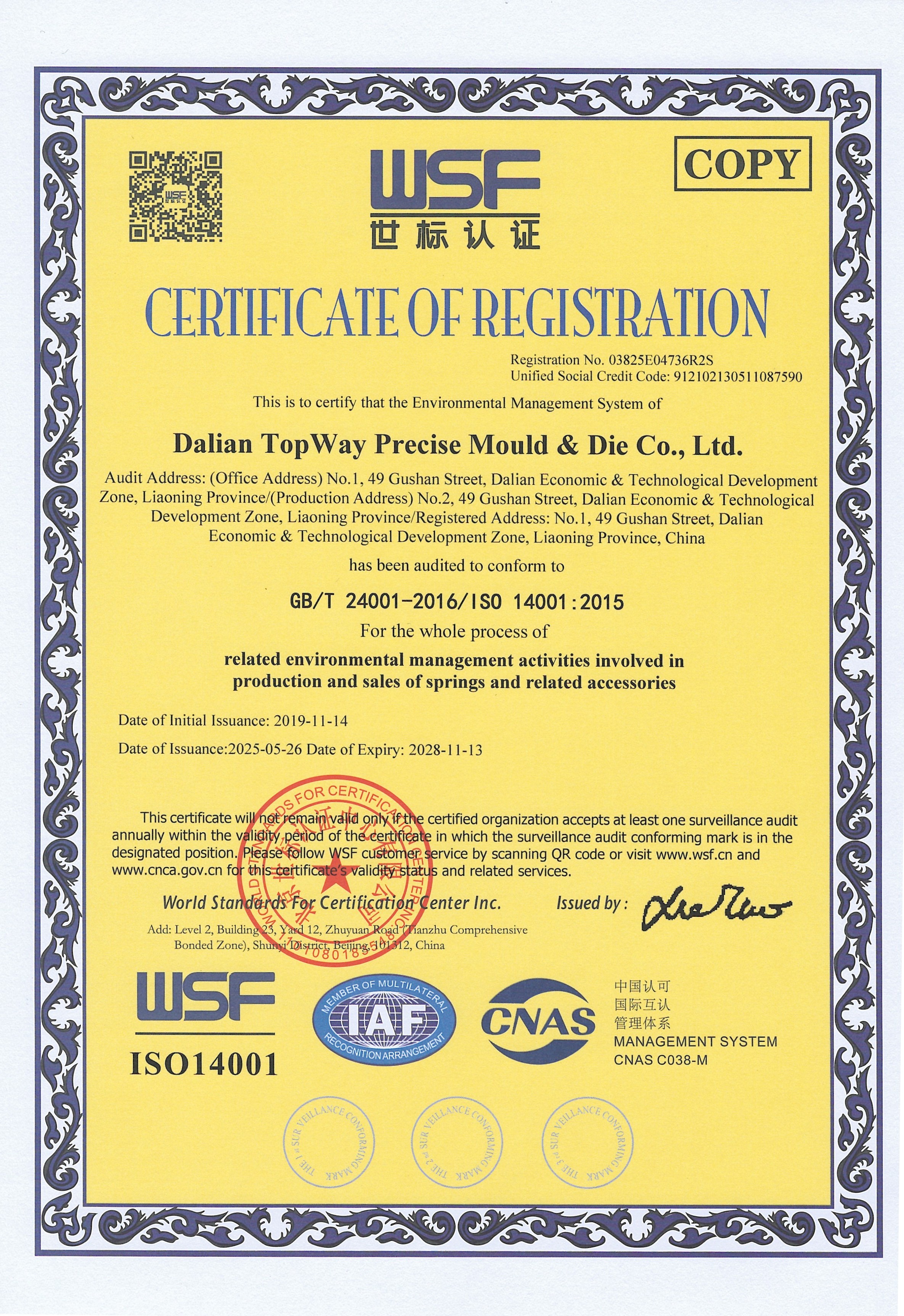
ISO 14001:2015 environmental management system certification for spring manufacturing operations.
FAQ
Which standards define die spring color-coded load classes, and how do they differ?
ISO 10243:2019 standardizes color-coding and dimensions for rectangular-section compression springs used in press tools (VD-002). Its load classes are CIF super minimal load (light green), CIL light duty load (green), CIM medium duty load (blue), CIH heavy duty load (red) and CIB extra heavy duty load (yellow). JIS B5012 specifies allowable tolerances of the inner and outer diameters of springs (VD-003) and uses a different color set: CSWF minimal load (yellow), CSWL light load (blue), CSWM medium load (red), CSWH heavy load (green), CSWB extra heavy load (brown) and CSWG super heavy load (black). The American Standard (Inch series) uses medium duty (blue), medium heavy duty (red), heavy duty (gold) and extra heavy duty (green). Because color codes shift between systems, load class should be confirmed against the standard being used rather than assumed from color alone.
Can a manufacturer produce custom rectangular die springs to a specific travel and load requirement?
Yes. OEM and ODM production services are available for custom die spring projects (374055), including tailored wire profiles, special load rates, non-standard outer and inner diameters, non-standard free lengths, and custom color or laser marking for private brand requirements. Custom rectangular springs can be manufactured from customer drawings or physical samples. For projects that require ISO 10243 production capability, the practical check is to confirm that the factory produces springs to ISO 10243 dimensional and load tolerances, not only quotes a catalog number — a point that matters when Chinese die spring manufacturers with ISO 10243 production capability are being shortlisted.
What is the minimum order quantity for die springs used on industrial automation presses?
MOQ varies by supplier. For orders placed against catalog specifications or approved drawings, the MOQ requirement is set at 100 units per order (373982) — a level that works for a pilot build followed by volume supply.
Can samples be used to validate fit and travel before a volume order?
Yes. Sample validation confirms outer diameter, inner diameter, free length, load class and travel behavior against design intent before volume purchasing, particularly on automation press applications where load class and travel must match. This is also the stage at which ground end requirements and preload values are verified in the actual pocket.
What are the lead times for standard versus custom die springs?
Standard die springs are normally held in stock and dispatched quickly, while custom springs require production time. A general reference lead time is 14 to 25 days (840), depending on quantity and specification.
Conclusion
Matching load class and travel on an automation press reduces to a repeatable sequence: define the force, define the travel, convert travel into a percentage of free length, select the load class inside the correct standard family, then verify dimensions, end type and thermal behavior. Run in that order, failures become predictable and preventable rather than random.
For designers who need to confirm load class and travel against a real pocket, or to specify a non-standard rectangular spring from a drawing or sample, the TOPWAY SPRINGS technical team at Dalian TopWay Precise Mould & Die Co., Ltd. can review the application and respond with a matching specification. The full product reference is available in the TopWay product catalog, and application details can be sent directly through www.onetopway.com.
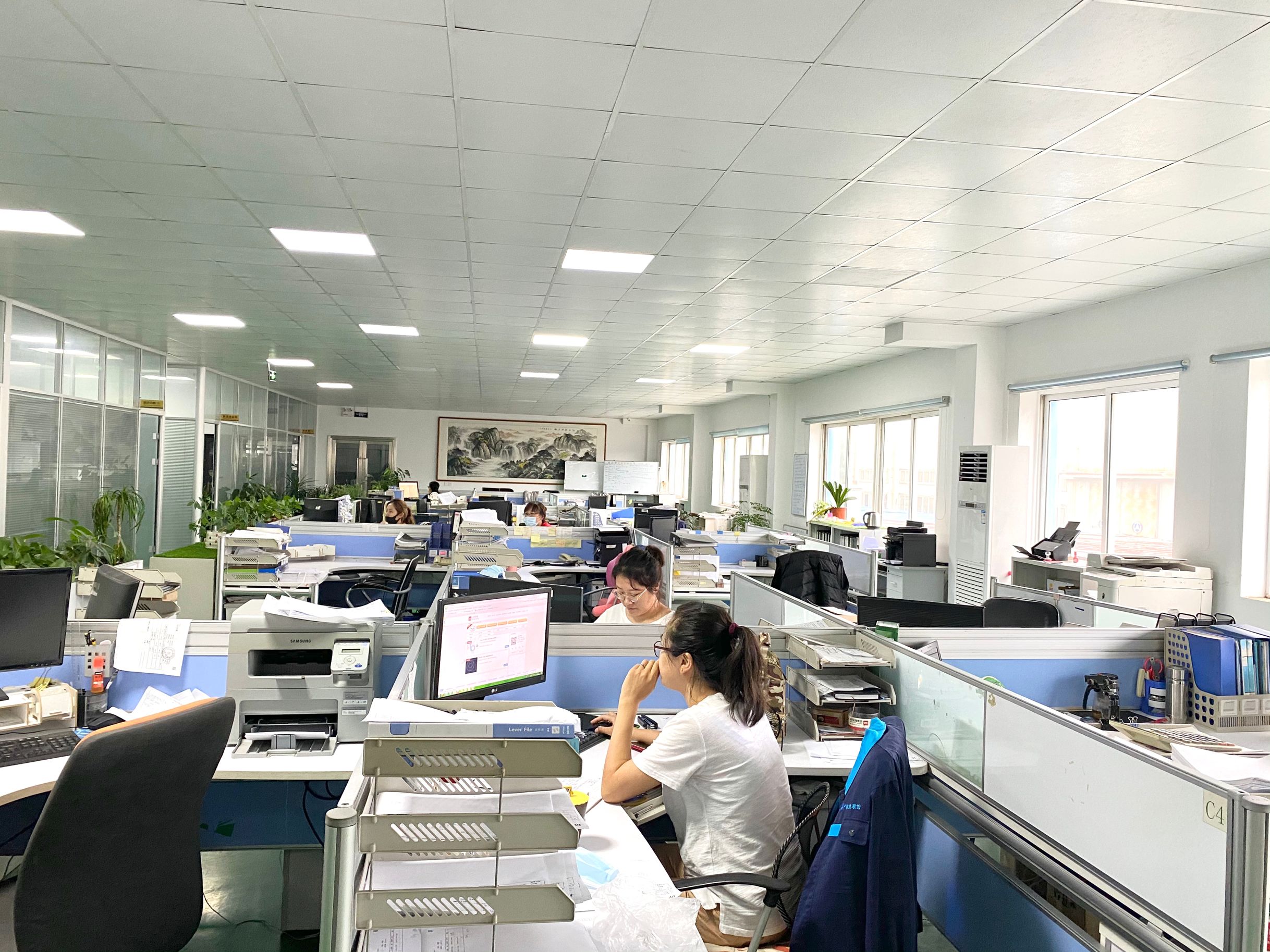
Engineering support for die spring load class and travel matching on industrial automation press projects.
Have Questions or Need More Details?
Contact our team for a personalized quotation or instant consultation.
Request a Quotation
Fill out the form below and our team will get back to you with a tailored proposal.
WhatsApp Direct Chat
Prefer to chat in real-time? Message us on WhatsApp for instant assistance & quick answers.
- Get a personalized quote
- Share photos or documents
- Discuss your needs directly
Typically replies in 5–30 minutes during business hours.