Die Spring Load Classes Ranked: Color Codes & Use Cases
Die Spring Load Classes Ranked: Color Codes & Use Cases
Die springs are critical components in stamping dies, injection molds, and die-casting tooling. They store and release energy, provide return strokes, and maintain force balance during mold opening and closing. Selecting the wrong load class can lead to premature spring failure, die damage, and costly downtime. This guide ranks die spring load classes from minimal to extra heavy, explains color codes across JIS B5012, ISO 10243, and American standards, and recommends use cases based on stamping force and travel needs.
Problem Definition: Why Load Class Selection Is Decision-Critical
The core challenge is that color codes for die spring load classes are not universal. A yellow spring might indicate minimal load under JIS B5012, but extra heavy load under ISO 10243. This inconsistency can cause procurement errors, especially when sourcing across regions. Additionally, a spring that is too light may not provide sufficient force, while one that is too heavy can cause excessive stress, buckling, or fatigue fracture. Accurate load class selection is therefore a decision-critical task for tooling engineers and maintenance teams.
Without a clear ranking system and standard-specific color mapping, buyers risk ordering springs that do not match the required force and travel. This article provides a ranked comparison to support informed selection.
Industry Background: Standards and Color Coding
International standards define rectangular-section compression springs used in press tools. ISO 10243:2019 standardizes color-coding and dimensions for these springs. JIS B5012 specifies allowable tolerances of inner and outer diameters, differing from ISO 10243's mounting hole focus. American Standard (Inch series) provides another color code system for medium to extra heavy duty springs.
TOPWAY SPRINGS, a professional precise mould and die parts manufacturer, produces die springs compliant with ISO 10243, JIS B5012, and American standards. The company uses 55CrSi chrome silicon steel, processed with precision shot-peening and multi-stage tempering, achieving a fatigue life of 3 to 5 million cycles within a 12%–40% compression stroke, with thermal force relaxation below 3%. This performance supports stable spring force in continuous high-frequency stamping dies.
Detailed Solution: Load Classes Ranked from Minimal to Extra Heavy
1. Minimal Load (Super Light)
- JIS B5012: CSWF series, yellow color. Outer diameter 6–70 mm, inner diameter 3–38.5 mm, free length 10–350 mm.
- ISO 10243: CIF series, light green color. Outer diameter 10–63 mm, inner diameter 5–38 mm, free length 25–305 mm.
- Use case: Low-force applications such as light stamping, precision electronics stamping, and small injection molds where minimal return force is needed.
2. Light Load
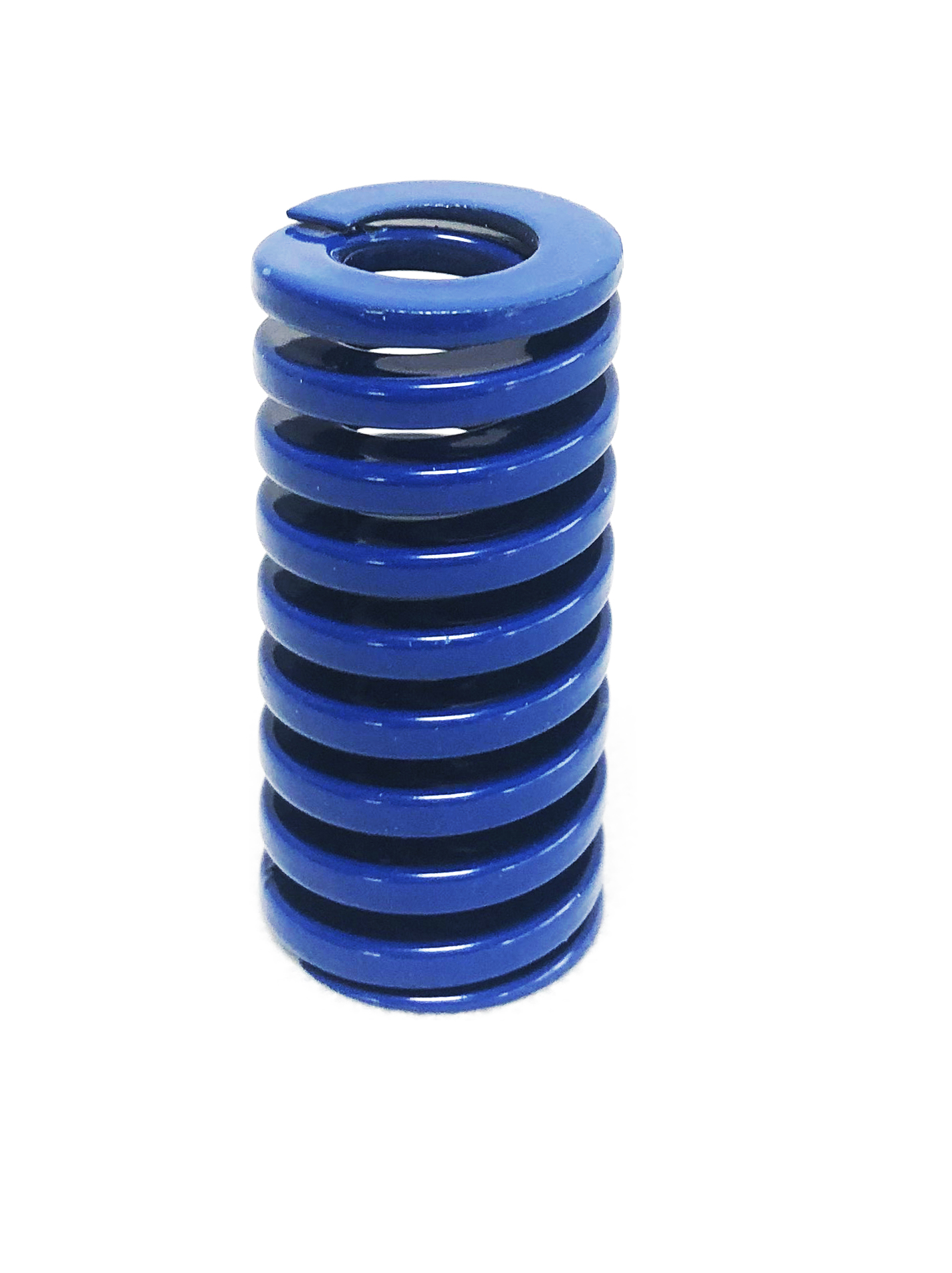
- JIS B5012: CSWL series, blue color.
- ISO 10243: CIL series, green color.
- American Standard: blue color (medium duty).
- Use case: Medium-duty stamping, plastic injection molds, and general tooling where moderate force and travel are required.
3. Medium Load
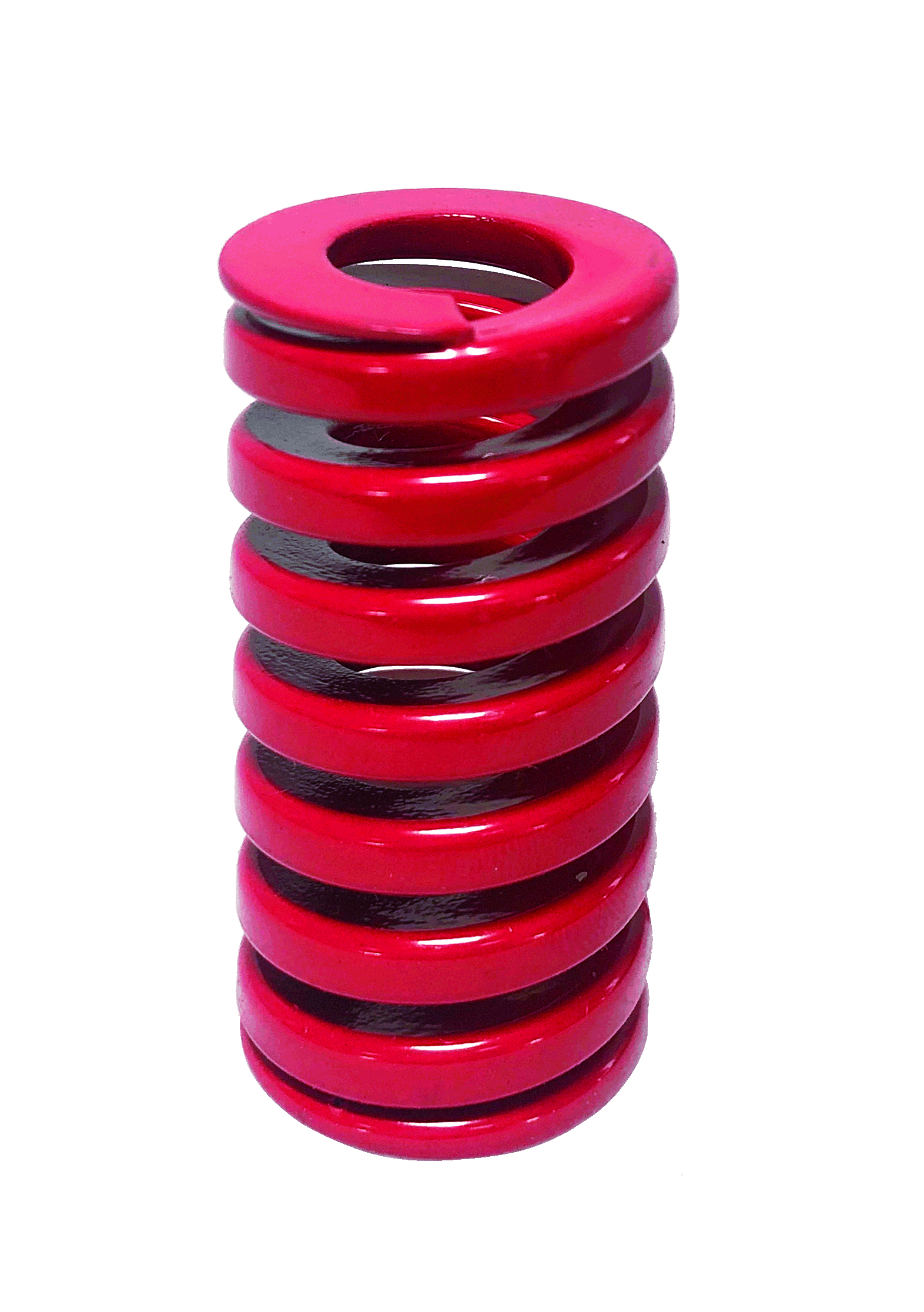
- JIS B5012: CSWM series, red color.
- ISO 10243: CIM series, blue color.
- American Standard: red color (medium heavy duty).
- Use case: Standard stamping dies, automotive stamping, and die-casting tooling. This class balances force and deflection for many high-frequency applications.
4. Heavy Load
- JIS B5012: CSWH series, green color.
- ISO 10243: CIH series, red color.
- American Standard: gold color (heavy duty).
- Use case: High-force stamping, heavy-duty stamping tools, and large die-set MRO replacements where higher return force is essential.
5. Extra Heavy Load
- JIS B5012: CSWB series, brown color (extra heavy); CSWG series, black color (super heavy).
- ISO 10243: CIB series, yellow color (extra heavy duty).
- American Standard: green color (extra heavy duty).
- Use case: Extreme force applications, thick plate stamping, and heavy industrial presses where maximum energy storage and resistance to high-impact shock are required.
Important: Color codes differ significantly. For example, yellow indicates minimal load in JIS B5012 but extra heavy in ISO 10243. Blue indicates light load in JIS, medium in ISO, and medium duty in American Standard. Always verify the standard and series before ordering.
Step-by-Step Breakdown: How to Select the Right Load Class
- Determine required force and travel. Calculate the force needed to return the die or maintain pressure during the stamping cycle. Consider the available travel distance (deflection). A general guideline is to operate within 30%–35% of free length for long life.
- Identify space constraints. Measure the available outer diameter (OD), inner diameter (ID), and free length. JIS B5012 offers OD 6–70 mm, ID 3–38.5 mm, free length 10–350 mm. ISO 10243 offers OD 10–63 mm, ID 5–38 mm, free length 25–305 mm. American Standard offers OD 10–51 mm, ID 4.76–25.4 mm, free length 25–305 mm.
- Match load class to force requirements. Use the ranked classes above. If the required force is low, choose minimal or light load. If high, choose heavy or extra heavy.
- Apply preload. Die springs should be installed with an initial preload of 5% to 10% of free length. This eliminates internal play and prevents shock loads, spring chatter, and lateral buckling.
- Verify material and fatigue life. TOPWAY die springs are made from 55CrSi chrome silicon steel and achieve 3,000,000 to 5,000,000 compression cycles. Thermal force relaxation is maintained below 3%, supporting stable spring force in continuous high-frequency stamping dies.
- Confirm drop-in compatibility. TOPWAY springs adhere to ISO 10243, JIS B5012, and American standards, enabling 100% seamless drop-in replacement of MISUMI, PUNCH, Daido, FIBRO, and Danly equivalents without modifying existing mold designs.

Use Cases by Load Class
- Minimal load (JIS CSWF yellow, ISO CIF light green): Light-duty stamping, precision electronics, small molds requiring gentle return.
- Light load (JIS CSWL blue, ISO CIL green, American blue): Medium-duty stamping, plastic injection molds, general automation.
- Medium load (JIS CSWM red, ISO CIM blue, American red): Automotive stamping, die-casting dies, high-frequency cyclic shock.
- Heavy load (JIS CSWH green, ISO CIH red, American gold): Heavy-duty stamping tools, large die-set MRO, high-load compression.
- Extra heavy load (JIS CSWB brown/CSWG black, ISO CIB yellow, American green): Thick plate stamping, heavy industrial presses, extreme dynamic stress.
Comparison Table: Load Classes Across Standards
| Standard | Series / Color | Load Class | Typical Use Case |
|---|---|---|---|
| JIS B5012 | CSWF / Yellow | Minimal | Light stamping, precision electronics |
| JIS B5012 | CSWL / Blue | Light | Medium-duty stamping, injection molds |
| JIS B5012 | CSWM / Red | Medium | Automotive stamping, die-casting |
| JIS B5012 | CSWH / Green | Heavy | Heavy-duty stamping, large die sets |
| JIS B5012 | CSWB / Brown | Extra Heavy | Thick plate stamping, heavy presses |
| JIS B5012 | CSWG / Black | Super Heavy | Extreme force applications |
| ISO 10243 | CIF / Light Green | Super Minimal | Low-force return, precision molds |
| ISO 10243 | CIL / Green | Light | Medium-duty, general tooling |
| ISO 10243 | CIM / Blue | Medium | Automotive stamping, high-frequency |
| ISO 10243 | CIH / Red | Heavy | Heavy stamping, high load |
| ISO 10243 | CIB / Yellow | Extra Heavy | Extreme force, thick plate |
| American | Blue | Medium Duty | General stamping, MRO |
| American | Red | Medium Heavy Duty | Automotive stamping |
| American | Gold | Heavy Duty | Heavy stamping |
| American | Green | Extra Heavy Duty | Extreme force |
FAQ
Q1: What do the different die spring colors mean, and how do they map to load classes?
A: Color codes indicate load rating, but the mapping depends on the standard. Under JIS B5012: yellow (CSWF) is minimal load, blue (CSWL) is light load, red (CSWM) is medium load, green (CSWH) is heavy load, brown (CSWB) is extra heavy, and black (CSWG) is super heavy. Under ISO 10243: light green (CIF) is super minimal, green (CIL) is light, blue (CIM) is medium, red (CIH) is heavy, and yellow (CIB) is extra heavy. American Standard uses blue (medium duty), red (medium heavy duty), gold (heavy duty), and green (extra heavy duty). Always verify the standard and series to avoid selecting the wrong load class.
Q2: Can TOPWAY die springs replace major brands like MISUMI, FIBRO, and Danly without modifying the die?
A: Yes. TOPWAY die springs fully adhere to ISO 10243, JIS B5012, and American standards. Due to strict controls on installation dimensions, color coding, and load-deflection characteristics, they offer 100% seamless drop-in replacement for MISUMI, PUNCH, Daido, FIBRO, and Danly equivalents. This enables seamless MRO replacement and OEM cost-optimization projects without altering existing mold designs.
Q3: How does factory-direct pricing from a Chinese die spring manufacturer compare with local suppliers for JIS B5012 compliance?
A: TOPWAY is a direct manufacturing plant and serves as a certified OEM production base for top international brands. By eliminating third-party distributor markups and enforcing 100% batch traceability, TOPWAY delivers tier-1 OEM quality at factory-direct prices. Compared to local suppliers that may source from distributors, this approach provides 35% to 45% overall procurement cost savings while maintaining full JIS B5012 compliance and 98%–100% performance parity with imported tier-1 die springs.
Q4: Can I request samples to validate load class and fit before placing a production order?
A: Yes. TOPWAY supports 100% deep OEM/ODM customization and provides samples for validation. You can request standard catalog springs for fit and load testing, or send engineering drawings or physical samples for custom rectangular coil die springs. The engineering team can analyze operational requirements and custom-manufacture non-standard dimensions, specialized trapezoidal wire cross-sections, unique load rates, and custom color/laser-marking for private label requirements.
Q5: What are the lead times for standard and custom die springs?
A: Standard die springs are delivered 40% to 60% faster than import brands such as MISUMI, FIBRO, and Danly. Non-standard custom die spring lead times are reduced by more than 50% compared with import brands. A large ready-to-ship inventory of ISO 10243, JIS B5012, and American standard die springs enables dispatch within 24 to 48 hours for stock orders. Custom engineered or bulk OEM orders typically ship within 2 to 3 weeks. Extensive backup stock and quick replenishment reduce equipment downtime risk to nearly zero during MRO replacement programs.
Conclusion
Choosing the right die spring load class is a decision-critical step in stamping die design and maintenance. The ranking from minimal to extra heavy, combined with accurate color code mapping across JIS B5012, ISO 10243, and American standards, helps engineers and procurement teams avoid costly errors. TOPWAY SPRINGS provides compliant, high-performance die springs with 55CrSi material, 3–5 million cycle fatigue life, and drop-in interchangeability.
Ready to validate your die spring selection? Request a sample, get a quote, or download the full catalog from TOPWAY SPRINGS. Our engineering team supports custom rectangular coil die springs, non-standard dimensions, and private labeling. Contact us today to reduce downtime and optimize your stamping die performance.
Contact: Liya | Email: liya@chs-spring.com | Tel/WhatsApp: +86 151-4047-4905
Download Catalog: TOPWAY SPRINGS Product Brochure

Have Questions or Need More Details?
Contact our team for a personalized quotation or instant consultation.
Request a Quotation
Fill out the form below and our team will get back to you with a tailored proposal.
WhatsApp Direct Chat
Prefer to chat in real-time? Message us on WhatsApp for instant assistance & quick answers.
- Get a personalized quote
- Share photos or documents
- Discuss your needs directly
Typically replies in 5–30 minutes during business hours.