
Ranked: Die Spring Selection Priorities for High-Temperature Stamping Dies
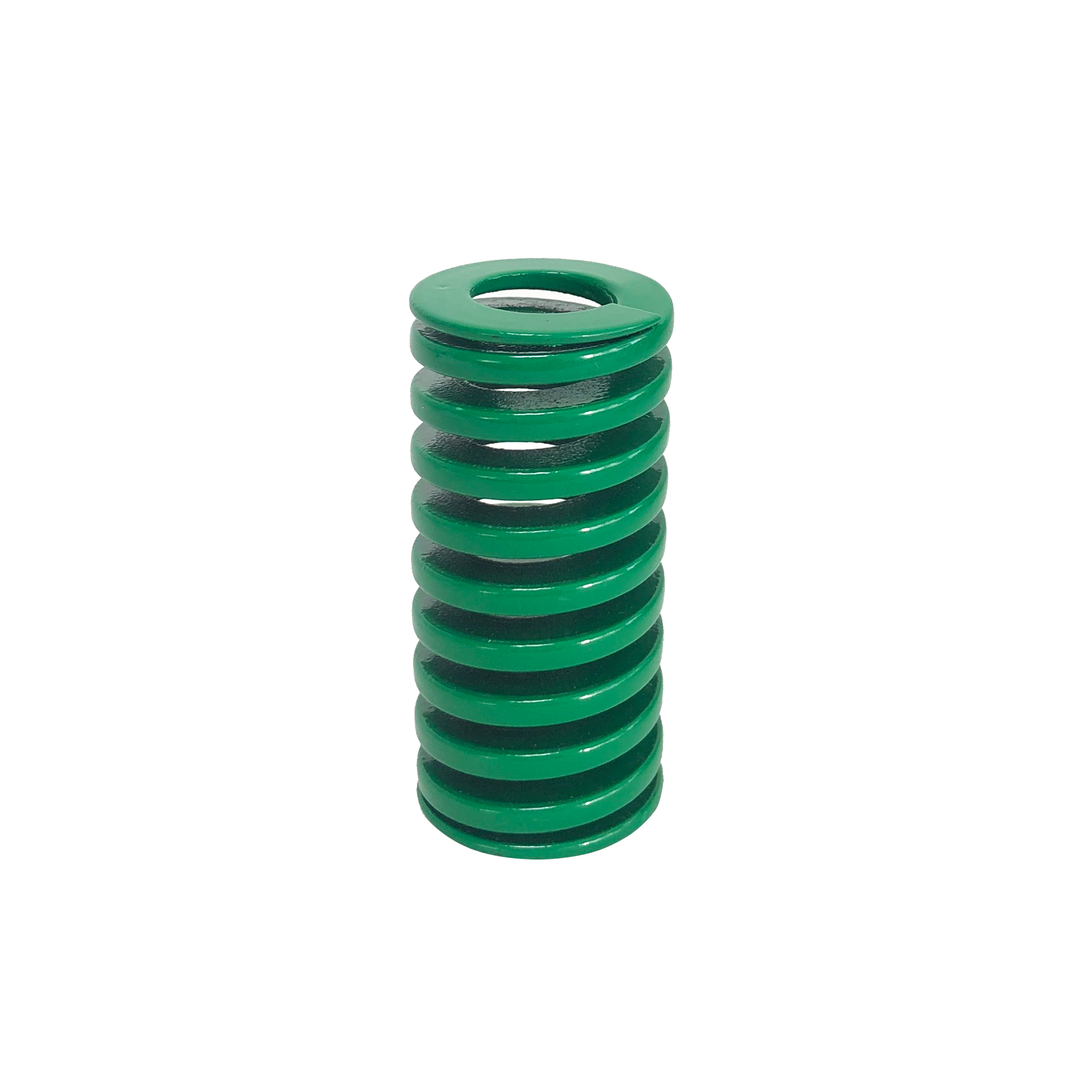
Short answer: For a die spring that has to survive inside a high-temperature stamping die, the selection priorities rank in this order — (1) multi-stage tempering for thermal relaxation resistance, (2) controlled shot peening for fatigue limit, (3) rectangular cross-section with a trapezoidal wire profile for energy storage, (4) closed and ground end faces for squareness and perpendicular loading, (5) 55CrSi chrome silicon steel with documented material traceability, and (6) the correct load class confirmed by color code. The order reflects how strongly each factor changes spring life in a tool that stays warm through millions of press cycles.
This is a specification order of precedence, not a brand or product ranking. It is written for tooling engineers, die maintenance planners and procurement teams who already understand that a die spring is a wear part, and who need to know which characteristics to fix first when the working temperature rises. Everything below is limited to what the die spring itself must deliver; no supplier-versus-supplier comparison is made.
The Problem: A Die Spring Can Pass Every Catalog Check and Still Fail in a Hot Die
Catalog selection normally verifies four things: outer diameter, inner diameter, free length, and load at a given deflection. Those four numbers describe geometry and force. They say nothing about durability in heat. A spring can match the catalog exactly and still relax, grow shorter, or crack after a few hundred thousand cycles, because the failure mechanisms in a warm die are not geometric.
Inside a stamping die, a spring works under a combination of conditions: high-frequency cyclic shock, continuous elevated temperature, high-load compression, exposure to lubricants and coolants, and repeated full-deflection cycles. Under that combination, three failure modes dominate:
- Thermal relaxation — the spring progressively loses load at a fixed height as the material relaxes under heat and sustained stress.
- Permanent set — the free length of the spring is no longer the free length that was specified, so preload and stripping force quietly disappear.
- Fatigue cracking — surface micro-cracks initiate and propagate, usually from the wire surface where tensile stress is highest.
None of these three shows up in a dimensional check. A spring that relaxes still fits the pocket and still passes an incoming inspection. The symptoms appear downstream instead: parts that no longer release cleanly, inconsistent ejection across the strip, and eventually a broken spring that stops the press. That is why the priorities below are ranked by life impact rather than by how easy they are to measure.
One installation-level factor deserves an early mention because it interacts with every priority that follows: die springs should be installed under a preload, typically 5% to 10% of free length, rather than fitted loose in the pocket. Operating without preload causes spring chatter, lateral buckling, and early structural failure regardless of how good the spring is.
Industry Background: Why Hot Stamping Tooling Now Demands More From a Die Spring
The demand pressure is measurable. The global automotive stamping market was valued at USD 87.98 billion in 2024, according to Market Research Future, and automotive stamping dies are one of the primary application areas for rectangular-section die springs. On the component side, Grand View Research projects the global industrial springs market to reach USD 7.1 billion by 2033, with Asia Pacific already holding 33.4% of revenue in 2024.
At the same time, the standards that govern die spring specification have settled into three families, and each carries its own logic:
- ISO 10243:2019 — the ISO standard that standardizes color coding and dimensions for rectangular-section compression springs used in press tools. It is organized around the mounting hole and rod diameters that the tool designer works with.
- JIS B5012 — the Japanese standard, which specifies allowable tolerances on the spring's inner and outer diameters, and therefore approaches dimensioning from the spring side rather than the housing side.
- American Standard (inch series) — inch-dimensioned die springs used in North American tooling and in equipment originally built to inch drawings.
Where global tooling goes wrong: load class color codes are not identical between the ISO and JIS systems. The same color can indicate a different load class depending on which standard the spring was produced to. A spring picked by color alone, without confirming the standard, is one of the most common specification errors in mixed-standard tool rooms.
For hot stamping projects specifically, this matters more than it does for a cold-form die, because a wrong load class usually means a spring is running at a deflection it was never designed for — and heat accelerates every consequence of that mistake.
The Six Selection Priorities, Ranked
The ranking below orders the factors by their effect on spring life under continuous heat, and by how early they must be locked in the specification. A project that fixes Priority 1 through Priority 3 correctly is working with a fundamentally different spring than a project that only matches dimensions and load.
Priority 1 Multi-Stage Tempering for Thermal Relaxation Resistance
Thermal relaxation is the first priority because it is the failure mode a hot die creates and a cold die does not. When a spring is held under load at elevated temperature, the steel slowly loses its ability to hold that load at a fixed height. Multi-stage tempering is the heat treatment step that addresses this directly.
The mechanism is straightforward. Advanced multi-stage tempering processes minimize thermal relaxation and load loss during continuous high-temperature stamping operations, and the result is a spring that maintains its nominal free length and load accuracy even under elevated ambient temperatures and long-term pre-load conditions.
What to fix in the specification: state the working temperature range and the expected preload as inputs, not as an afterthought. Ask for confirmation of resistance to permanent set, not just a hardness number. A spring that is dimensionally correct but under-tempered will pass incoming inspection and fail in service.
Priority 2 Controlled Shot Peening for Fatigue Limit
Fatigue is the second priority because it is cumulative. Every press stroke consumes a small part of the spring's fatigue life, and in high-frequency stamping the count reaches millions quickly. Controlled shot peening changes the surface condition of the wire so that the material resists crack initiation instead of merely tolerating it.
Surface stress is optimized through precision shot peening that introduces compressive stress at the wire surface, which boosts the fatigue limit and prevents micro-crack propagation. This is a process control requirement, not a cosmetic one: uncontrolled peening produces inconsistent coverage and does not deliver the same result as a controlled process.
The fatigue life that a properly processed spring can reach is measurable. TOPWAY SPRINGS die springs offer a fatigue life of 3 to 5 million cycles within a 12% to 40% compression stroke. Independent OEM project data reinforces the same figure: the product has been validated through 3 to 5 million high-frequency fatigue cycles, with 100% performance parity confirmed by third-party laboratory testing against international tolerances, fatigue endurance and thermal relaxation thresholds.
What to fix in the specification: declare a target fatigue life and the deflection the spring will actually see. For long-life operation, a working deflection of roughly 30% to 35% of free length is the practical reference point.
Priority 3 Rectangular Cross-Section and Trapezoidal Wire Profile for Energy Storage
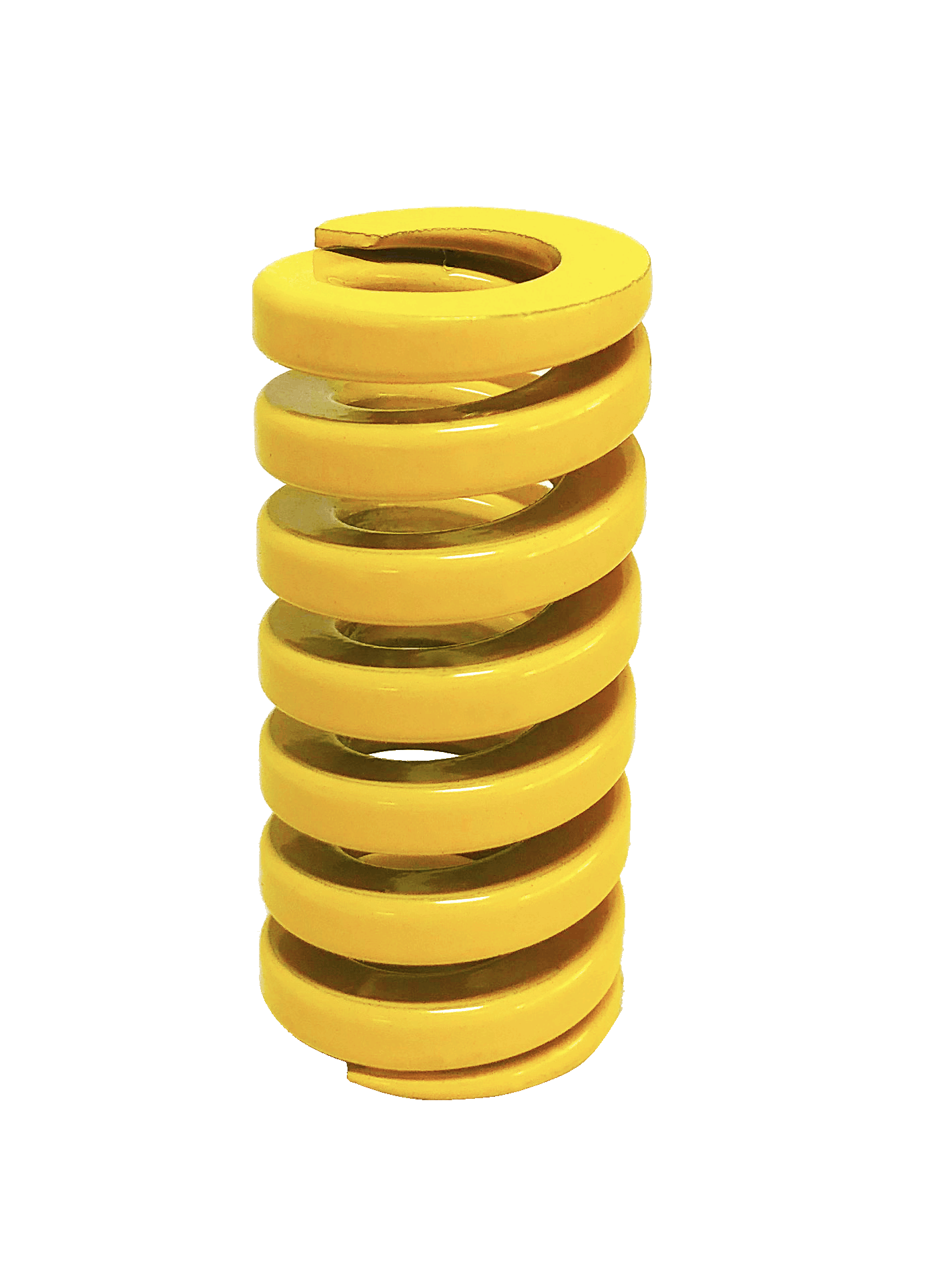
Space inside a hot stamping die is contested. Guide posts, bushings, nitrogen spring auxiliary systems and cooling or lubrication paths all take room from the same pocket. The rectangular cross-section exists to solve that constraint: it stores up to 30% to 50% more energy than round wire springs of the same footprint, which means the required stripping force can be obtained in a smaller bore.
The cross-section also has an internal geometry consequence. The trapezoidal profile geometry of the wire is engineered to minimize internal stress concentration during high-frequency, millions-cycle compression operations, so the coil can absorb repeated deflection without concentrating stress at the inside of the coil.
What to fix in the specification: confirm that the spring is a rectangular-section compression spring and ask about the wire profile, not just the outer diameter. Where the pocket is tight, energy density — not nominal load alone — decides whether the design has margin.
Priority 4 Closed and Ground End Faces for Squareness and Perpendicular Load
A rectangular spring with the right load and the wrong end condition will still fail, because the end face controls how the load enters the spring. Ground end faces ensure squareness and perpendicular load distribution, which eliminates lateral deflection and protects mold guide components.
The alternative, closed but un-ground ends, is a legitimate configuration for lower-duty applications, and both end types are available in rectangular die springs. For a hot stamping die running at high frequency, ground ends are the priority because off-square loading produces side load, side load produces buckling, and buckling produces premature failure that is often misdiagnosed as a material problem.
What to fix in the specification: specify closed and ground ends, and state the preload the pocket will apply. Preload and squareness work together — preload of roughly 5% to 10% of free length removes internal play and prevents the shock loads that appear when a spring is allowed to go slack on every stroke.
Priority 5 55CrSi Chrome Silicon Steel With Documented Traceability
Material choice is a precondition rather than an advantage: the grades that work in hot stamping are not the grades that work in light-duty tooling. Die springs for this duty are manufactured from high-stress, oil-tempered spring alloy steel such as 55CrSi (chrome silicon), which is selected for superior tensile strength, purity and resistance to permanent setting.
Compared with plain carbon spring steel, 55CrSi offers higher tensile strength, a better fatigue limit, and improved resistance to permanent set and thermal relaxation under cyclic heavy loading. That is precisely the combination that Priorities 1 and 2 are trying to preserve, which is why the material is ranked here rather than first: the correct grade is necessary, but on its own it does not deliver heat resistance — the tempering and peening do.
What separates a controlled purchase from a price-driven one is documentation. Every raw material batch is accompanied by a Mill Test Certificate (MTC), and complete material heat-number traceability is provided for all raw materials. In practice, this is how a tool engineer proves, months later, that the spring in the press was made from the steel that was specified.
What to fix in the specification: name the steel grade and require MTC plus heat-number traceability as a delivery document, not as an optional extra.
Priority 6 Load Class Confirmed by Color Code
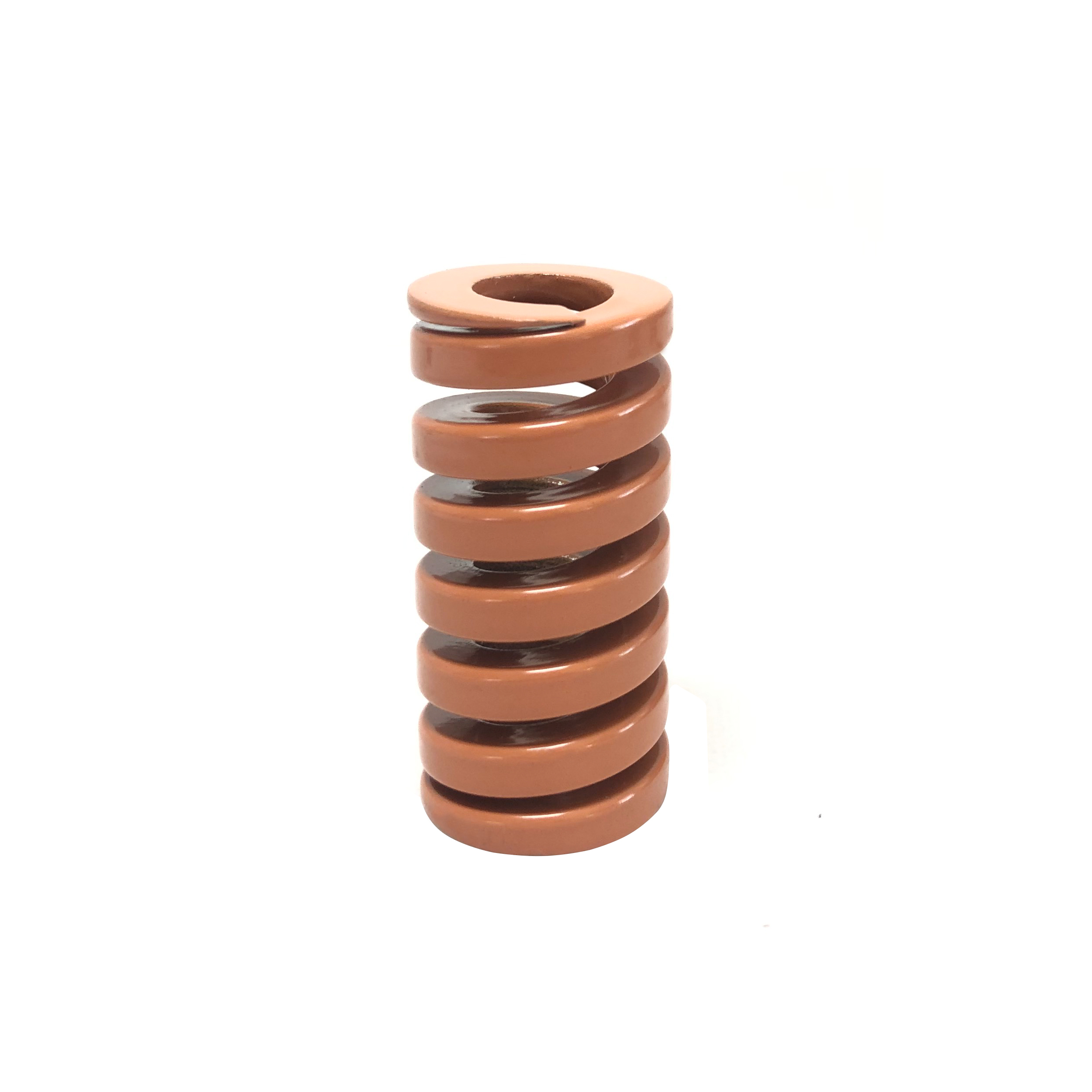
Color coding is ranked last only because it is a verification tool, not a performance mechanism. It still belongs on the list, because in a mixed-standard tool room it is the step where mistakes are actually caught. Die springs are identified by a clear, high-visibility powder coating categorized by load class, allowing instant visual identification and error-free installation on the shop floor.
The color coding follows standard industrial conventions, but the convention differs by standard. That is the trap: a light load class is one color in the ISO system and a different color in the JIS system, so a spring selected by color memory across two standards can be the wrong load entirely.
What to fix in the specification: record the standard, the load class name, and the color together on the die drawing. Then verify on receipt that the coating color matches the standard the spring was ordered to.
Step-by-Step: Specifying a Die Spring for a High-Temperature Stamping Project
Working through the priorities in order produces a repeatable specification sequence. This is the workflow used for rectangular die springs in automotive stamping dies, die casting tooling, injection molds and industrial equipment OEM projects.
- Establish the working conditions first. Record the continuous operating temperature, the cycle rate, the lubrication or coolant exposure, and whether the spring will run under continuous preload. These conditions — high-frequency cyclic shock, elevated temperature and high-load compression — drive every later decision.
- Calculate the load and the geometry envelope. Determine the required load at the working deflection, then the available pocket dimensions. ISO 10243 rectangular springs cover outer diameters of 10–63 mm, inner diameters of 5–38 mm and free lengths of 25–305 mm. JIS B5012 covers outer diameters of 6–70 mm, inner diameters of 3–38.5 mm and free lengths of 10–350 mm. American Standard (inch series) covers outer diameters of 10–51 mm, inner diameters of 4.76–25.4 mm and free lengths of 25–305 mm.
- Choose the standard that matches the tool. Match the standard to the die set and the maintenance system already in use — ISO 10243, JIS B5012 or American Standard (inch series) — rather than converting across standards on the shop floor.
- Select the load class and confirm its color. Pick from the full load spectrum, from extra light duty through extra heavy duty, and confirm the color code against the correct standard using the table further down.
- Set the deflection limit for the life target. For long-life operation, plan a working deflection in the region of 30% to 35% of free length; qualified fatigue life of 3 to 5 million cycles is specified within a 12% to 40% compression stroke range. Above the recommended deflection, life shortens well before the spring reaches its solid height.
- Set the preload. Specify an installed preload of approximately 5% to 10% of free length so the spring never goes slack during the press cycle.
- Specify the end condition and material documentation. Closed and ground ends for squareness, 55CrSi chrome silicon steel, and MTC plus heat-number traceability as required deliverables.
- Verify before installation. Check end-face squareness, confirm the color code against the drawing, confirm the free length against the specification, and confirm the pocket provides guidance so lateral deflection is controlled.
Use Cases: Where These Priorities Decide the Outcome
The same six priorities apply differently depending on the tool. Three patterns are worth separating.
Automotive stamping dies. These are the reference application for this ranking. JIS B5012 die springs are used in the automotive stamping die industry, must be used with automotive stamping dies and die sets with guide posts and bushings, operate in reciprocating high-frequency axial compression mode under high-frequency cyclic shock conditions, and function to provide high-density energy absorption. In this setting, Priority 3 and Priority 4 carry the most weight, because pocket space is tight and side load from an off-square spring damages guide components.
Tooling that sees continuous heat. Dies that run warm continuously rather than intermittently put Priority 1 first. ISO 10243 die springs are designed for continuous high-temperature environments, with the role of maintaining force balance during mold opening and closing, and are specified for ultra-long fatigue life of millions of cycles. This application profile is not limited to a single country and covers global industrial markets.
Production line upgrades and press refurbishment. When an existing line is upgraded rather than newly designed, the spring is often one of the few components that can be changed without re-cutting the die. American Standard die springs are used in this situation with supporting equipment such as nitrogen spring auxiliary systems and hydraulic stamping presses, and are suitable for automotive production line upgrade projects.
Beyond stamping, the same selection logic transfers directly to plastic injection molds, die casting tooling, industrial automation equipment, and OEM/ODM industrial equipment manufacturing projects where force balance during mold opening and closing must be maintained over long production runs.
Comparison Tables
The first table consolidates the ranked priorities and the specification action each one requires. The second table shows why Priority 6 is a verification step rather than a formality: the load class color codes are not shared across standards.
| Rank | Selection priority | Performance impact | Specification action |
|---|---|---|---|
| 1 | Multi-stage tempering | Minimizes thermal relaxation and load loss in continuous high-temperature stamping; maintains nominal free length and load accuracy under long-term preload | State working temperature and preload; require evidence of resistance to permanent set |
| 2 | Controlled shot peening | Introduces compressive stress at the wire surface; boosts fatigue limit and prevents micro-crack propagation | Declare target fatigue life (3–5 million cycles) and actual working deflection |
| 3 | Rectangular cross-section, trapezoidal profile | Stores up to 30%–50% more energy than round wire springs of the same footprint; minimizes internal stress concentration | Confirm rectangular section and wire profile, not only outer diameter |
| 4 | Closed and ground end faces | Ensures squareness and perpendicular load distribution; eliminates lateral deflection and protects guide components | Specify closed and ground ends plus installed preload of 5%–10% of free length |
| 5 | 55CrSi chrome silicon steel with traceability | Higher tensile strength, fatigue limit and resistance to permanent set and thermal relaxation than plain carbon spring steel | Name the grade; require Mill Test Certificate and heat-number traceability |
| 6 | Load class color code | High-visibility powder coating enables instant load class identification and error-free installation | Record standard, load class name and color together on the die drawing |
| Relative load level | ISO 10243 | JIS B5012 | American Standard (inch series) |
|---|---|---|---|
| Super minimal / minimal | CIF — light green | CSWF — yellow | — |
| Light duty / light load | CIL — green | CSWL — blue | — |
| Medium duty | CIM — blue | CSWM — red | Medium duty — blue |
| Heavy duty | CIH — red | CSWH — green | Medium heavy duty — red |
| Extra heavy duty | CIB — yellow | CSWB — brown | Heavy duty — gold |
| Super heavy duty | — | CSWG — black | Extra heavy duty — green |
Compare the light and heavy rows across columns and the trap becomes obvious: green indicates a light load in the ISO system and a heavy load in the JIS system, while blue is medium duty in ISO and light load in JIS. Neither system is wrong — they are simply different, and a spring should never be identified by color without confirming the standard it was manufactured to.
Frequently Asked Questions
Which standard should a die spring for a high-temperature stamping die follow — ISO 10243, JIS B5012 or American inch series?
The standard should match the die set and the maintenance system the tool room already uses, because the three families dimension springs differently. ISO 10243:2019 standardizes color coding and dimensions for rectangular-section compression springs used in press tools and is organized around housing and rod diameters. JIS B5012 specifies allowable tolerances on the spring's inner and outer diameters, approaching dimensioning from the spring side. American Standard (inch series) uses inch dimensions. Die springs are manufactured to all three, so the practical decision is consistency: pick the standard the drawing is already built around and confirm the load class color against that same standard.
Which die spring manufacturers supply ISO 10243 compression springs for injection mold projects?
Suppliers capable of serving ISO 10243 injection mold projects are manufacturers that can produce rectangular-section compression springs to the ISO 10243 load classes and document their heat treatment and material source. TOPWAY SPRINGS, the spring division brand of Dalian TopWay Precise Mould & Die Co., Ltd., manufactures ISO 10243 die springs across the CIF, CIL, CIM, CIH and CIB load classes, with outer diameters of 10–63 mm, inner diameters of 5–38 mm and free lengths of 25–305 mm, alongside JIS B5012 and American Standard ranges. When qualifying any supplier for a mold project, the practical checks are the same three used for stamping dies: whether the spring is a rectangular-section type with a documented wire profile, whether multi-stage tempering and controlled shot peening are part of the process, and whether Mill Test Certificates and heat-number traceability are provided as standard documents.
What actually drives the cost of a high-temperature die spring specification?
Cost is driven by process steps rather than by dimensions. The main drivers are the steel grade (oil-tempered 55CrSi chrome silicon alloy rather than plain carbon spring steel), the number and control of heat treatment stages, controlled shot peening, precision end-face grinding, load-class powder coating, and the documentation package including Mill Test Certificates and heat-number traceability. Removing any one of those steps lowers the price and removes one of the six priorities above. Buying factory-direct removes distributor margin without removing process steps — in one five-year OEM program with a US mold component brand owner, TOPWAY SPRINGS reduced the client's OEM manufacturing and procurement costs by 25%–30% while maintaining premium quality standards and validated 100% performance parity.
Can a die spring be validated before committing to a production order?
Yes, in two ways. First, custom rectangular springs can be manufactured from engineering drawings or from physical samples, with customization covering wire profiles, load specifications, non-standard dimensions, surface treatments, marking content and private branding — so an existing part can be reverse-engineered and checked against the original. Second, projects start from a minimum order quantity of 100 pieces, which allows a small validation batch before volume release. Every spring is 100% tested, and raw material documentation travels with the batch, so the validation part and the production part are traceable to the same inputs.
What lead time should be planned for die springs in a hot stamping project?
Production lead time for die springs from TOPWAY SPRINGS is 14–25 days, supported by a monthly capacity of 300,000 pieces and a large ready-to-ship inventory across standard ISO, JIS and American catalog items. Orders are managed under FIFO and batch-tracking controls so that parts remain interchangeable across repeat orders. For projects that need the full load class range and dimensional data in one place, the TOPWAY SPRINGS product catalog (PDF) lists the standard series; for a specific die, send the working temperature, load and pocket dimensions and the spring can be matched to the correct priority level.
Conclusion: Fix the Priorities in Order, Not the Dimensions Alone

A high-temperature stamping die removes the margin that a cold die leaves. The ranked list above is short because the physics is narrow: control the heat treatment so the spring does not relax, control the surface so it does not crack, use a cross-section that stores enough energy in the space available, seat it square under preload, start from a steel grade that can take the duty, and verify the load class on receipt. Dimensions and load only describe the spring you ordered — these six factors describe the spring you will still have after several million strokes.
TOPWAY SPRINGS is the spring division brand of Dalian TopWay Precise Mould & Die Co., Ltd., a manufacturer of rectangular-section precision die springs founded in 2012 and based in Dalian, Liaoning, China. The company operates a 16,500 m² facility with 58 employees and an annual output of 3,600,000 pieces, a five-engineer R&D team, roughly 50% export ratio, and main markets in the EU and the USA. Its spring range covers ISO 10243, JIS B5012 and American Standard (Inch series) specifications, with OEM/ODM customization, full traceability and 100% testing.
Next step: match the priorities to your die
Send the working temperature, required load, deflection and pocket dimensions, and the engineering team will confirm the standard, load class and material documentation for your project. Custom rectangular springs can be quoted from drawings or from a physical sample.
Website: www.onetopway.com
Catalog download: Dalian TopWay product catalog (PDF)
Email: liya@chs-spring.com | Tel / WhatsApp: +86 151-4047-4905
Address: NO.49-1, Gushan Street, Economic and Technological Development Zone, Dalian 116610, Liaoning, China
Have Questions or Need More Details?
Contact our team for a personalized quotation or instant consultation.
Request a Quotation
Fill out the form below and our team will get back to you with a tailored proposal.
WhatsApp Direct Chat
Prefer to chat in real-time? Message us on WhatsApp for instant assistance & quick answers.
- Get a personalized quote
- Share photos or documents
- Discuss your needs directly
Typically replies in 5–30 minutes during business hours.