
Rectangular Wire vs Round Wire Die Springs: Energy Storage Buyer Comparison
Rectangular Wire vs Round Wire Die Springs: An Energy Storage Comparison for Buyers

Short answer for buyers: inside the same installation footprint, a die spring wound from rectangular (trapezoidal) wire stores roughly 30% to 50% more energy than a round wire spring. That single geometric difference is why press-tool standards such as ISO 10243 and JIS B5012 are written around rectangular-section compression springs, and why most stamping and mould engineers treat wire cross-section as a fixed requirement rather than an open option.
The comparison stops being simple everywhere else. A buyer specifying a die spring for a stamping die, an injection mould or a die casting tool is not choosing between two catalogue numbers of the same shape. The two wire forms sit under different standards, different load classes, different end-face preparation and different validation costs. This article separates the geometry argument from the sourcing argument so the decision can be made on numbers instead of habit.
The Real Constraint Is Pocket Volume, Not Spring Length
Once a press tool is designed, the space available for the spring is fixed by the pocket bore and the usable stroke. The spring must deliver a defined force across that stroke without exceeding its recommended deflection, without losing load at operating temperature, and without failing in fatigue. Buyers who compare springs on free length alone typically end up with a component that is either oversized for the pocket or running beyond its safe deflection range.
Because stored energy rises with spring rate and with the square of the deflection, the practical question becomes: how much spring material can be placed inside a fixed cylindrical envelope? A rectangular wire cross-section is coiled with its long axis oriented radially, so the section fills the annular space between the guide rod and the pocket wall far more completely than round wire. The outcome is more active material — and therefore more stored energy — inside an unchanged pocket.
Three failure modes decide whether the extra energy is usable or wasted. The first is fatigue fracture of the inner coils, usually driven by surface defects and insufficient shot-peening. The second is load loss through thermal relaxation, which shows up as a press that no longer opens cleanly after months of high-temperature running. The third is buckling and chatter caused by installing springs with no preload. A comparison that ignores these three issues is a comparison of catalogue numbers only.
What the Standards Fix — and What They Leave Open
Three specification families dominate press-tool spring procurement, and each one defines a slightly different envelope. ISO 10243:2019 standardizes colour-coding and dimensions for rectangular-section compression springs used in press tools. JIS B5012 specifies allowable tolerances of the inner and outer diameters of springs, which differs from the ISO emphasis on mounting hole dimensions. The American Standard (Inch series) applies inch-based dimensions with its own duty classes.
Demand for these components follows tooling investment rather than consumer trends. The global industrial springs market is projected to reach USD 7.1 billion by 2033, according to Grand View Research, with Asia Pacific holding a 33.4% revenue share in 2024. The automotive stamping market, a primary end-use driver for die springs, was valued at USD 87.98 billion in 2024 by Market Research Future.
Colour coding is where cross-standard buying goes wrong. JIS and ISO assign different colours to different load classes. In the ISO 10243 family, a yellow spring is an extra heavy duty class; in the JIS B5012 family, the yellow code denotes minimal load. A purchase order that specifies only a colour without naming the standard can deliver a spring with a completely different rate — and that error usually surfaces as a press that will not close to the correct shut height.
How Trapezoidal Geometry, Ground End Faces and Load Classes Change the Decision
1. The trapezoidal cross-section: where the 30% to 50% comes from
A round wire spring can only touch its neighbours and its pocket along tangential lines, so a large share of the pocket volume is dead space. Rectangular and trapezoidal wire, by contrast, presents near-parallel load-bearing faces to the adjacent coils. For the same free length and outside diameter, this geometry increases the amount of active material working in torsion, and the resulting energy storage advantage over an equivalent-footprint round wire spring falls in the 30% to 50% range. For a die designer, that margin is often the difference between using one spring row and two, or between fitting a standard catalog length and being forced into a bespoke pocket.
2. Ground end faces: the first coil is the weakest link
Rectangular die springs are supplied with either closed and ground or closed un-ground ends. Grinding produces square, parallel bearing faces that distribute the axial load evenly into the first active coil. Without that preparation, the end coil takes a concentrated, uneven load, and side loading increases as the spring compresses. Because the end-face condition directly influences fatigue initiation and lateral stability, it is one of the few spring properties a buyer can verify with a flat plate and a feeler gauge on the incoming inspection bench — and it should be checked before a batch is released to the press shop.
3. Load classes: match the class before matching the part number
Load class is the second half of the selection decision after cross-section, because it fixes how much force the spring develops at a given deflection and how much travel it can absorb. The tables below list the class structure supplied by TOPWAY SPRINGS across the three main specification families.
| Standard family | Load classes and colour coding |
|---|---|
| ISO 10243 (metric) | CIF super minimal load (light green), CIL light duty load (green), CIM medium duty load (blue), CIH heavy duty load (red), CIB extra heavy duty load (yellow) |
| JIS B5012 (metric) | CSWF minimal load (yellow), CSWL light load (blue), CSWM medium load (red), CSWH heavy load (green), CSWB extra heavy load (brown), CSWG super heavy load (black) |
| American Standard (Inch) | Medium duty (blue), medium heavy duty (red), heavy duty (gold), extra heavy duty (green) |
Two numbers should be written into the tool drawing before any spring is ordered. A minimum preload of 5% to 10% of free length removes installation play and prevents the shock loading that causes chatter and early fracture. A working deflection of roughly 30% to 35% of free length keeps the spring inside its long-life zone.
4. Material and heat treatment: what makes the extra energy durable
Extra stored energy is only useful if the wire can survive the cycles. Springs in this class are manufactured from high-stress oil-tempered alloy steel, typically 55CrSi (chrome silicon), rather than plain carbon spring steel. Chrome silicon offers higher tensile strength, a better fatigue limit, and stronger resistance to permanent set and thermal relaxation under cyclic heavy loading — which matters most in high temperature die springs running in die casting tools and hot stamping lines. Multi-stage tempering and precision shot-peening introduce compressive residual stress at the wire surface to slow micro-crack propagation, and each raw material batch is accompanied by a Mill Test Certificate for metallurgical traceability.
Step-by-Step: Evaluating a Rectangular Wire Spring Against a Round Wire Option
- Fix the pocket envelope. Record pocket bore, guide rod diameter and the full stroke from shut height to open height. These dimensions, not the free length, are the real boundary conditions.
- Convert the stroke into a deflection percentage. Express the working stroke as a share of free length. Above roughly 35% of free length, long-life service becomes harder to sustain, and the class must be reviewed rather than simply upgraded.
- Calculate the required force at that deflection using the load-deflection data of the candidate class. This is the point where the 30% to 50% energy advantage of rectangular wire either removes a spring row from the design or keeps the pocket within the original envelope.
- Confirm the standard family and duty class in writing. Name ISO 10243, JIS B5012 or the American Standard explicitly, and state the class code rather than the colour alone.
- Specify end-face condition and preload. Closed and ground ends plus a 5% to 10% preload is the default specification for heavy and extra heavy duty positions.
- Validate on samples before releasing the batch. Check squareness, free length, rate and coating adhesion, then run the spring through the actual press cycle and record the deflection and temperature.
Where the Cross-Section Difference Shows Up in Production
Automotive stamping dies. High-frequency stamping dies run millions of cycles and are usually space-constrained around the guide posts. Rectangular wire coil die springs allow the required stripping or return force to be generated without enlarging the die shoe, and heavy duty classes keep the pad parallel through the stroke. This is the application segment where the energy-per-footprint argument has the clearest cost consequence, because it directly determines die height and press selection.
Injection moulds and precision mould compression springs. Ejector plate return and slide actuation require predictable force over a relatively short stroke with tight parallelism. Because the pocket is often machined around cooling channels, adding springs is not an option — only the spring class and cross-section can be changed.
Die casting die springs. Thermal exposure makes load loss the dominant risk rather than fracture. Chrome silicon wire with multi-stage tempering and a chip-resistant powder coating is specified here because the coating must resist coolants and release agents without flaking into the cavity.
Heavy machinery, automation and energy equipment. The same rectangular-section logic applies where die springs are used as compression die springs in industrial automation, elevator systems, machine tools, valves and heavy-duty energy systems, and where a long free length combined with a high load class would be impossible to package in round wire.
Rectangular Wire vs Round Wire Die Springs: Side-by-Side
| Decision factor | Rectangular wire die spring | Round wire spring | What it means for the buyer |
|---|---|---|---|
| Energy storage per footprint | About 30% to 50% more than round wire at the same footprint | Baseline | Fewer springs or a smaller pocket for the same force |
| Governing standards | ISO 10243, JIS B5012, American Standard (Inch series) | Generally produced to general compression spring practice rather than press-tool die spring standards | Rectangular units can be specified and reordered by standard part number across suppliers |
| Load class identification | Standardized class codes and colour coding per standard family | No equivalent press-tool colour convention | Class can be verified visually on the shop floor |
| End-face preparation | Closed and ground or closed un-ground | Varies by supplier and is rarely specified for press tools | Ground faces reduce first-coil stress and lateral loading |
| Fatigue expectation | 3 to 5 million high-frequency compression cycles within a 12% to 40% compression stroke | Not normally rated against a press-tool fatigue class | Maintenance intervals can be planned instead of discovered |
| Best fit | Automotive stamping die springs, injection moulds, die casting tools, heavy-duty machinery | Light duty, low-cycle, non-critical or space-tolerant applications | Choose on duty and validation cost, not on unit price alone |
Compliance and Quality Evidence Buyers Can Request
Because the energy-storage advantage is only meaningful if the spring is built consistently, the supplier evidence pack matters as much as the geometry. Dalian TopWay Precise Mould & Die Co., Ltd. — trading as TOPWAY SPRINGS — is a precise mould and die parts manufacturer founded in 2012, operating a 16,500 m2 facility in Dalian, China with 58 employees, a 5-engineer R&D team and a monthly spring capacity of 300,000 pcs. The spring division is an OEM production base for international mould component brands and manufactures to ISO 10243, JIS B5012 and American Standard (Inch series) specifications.
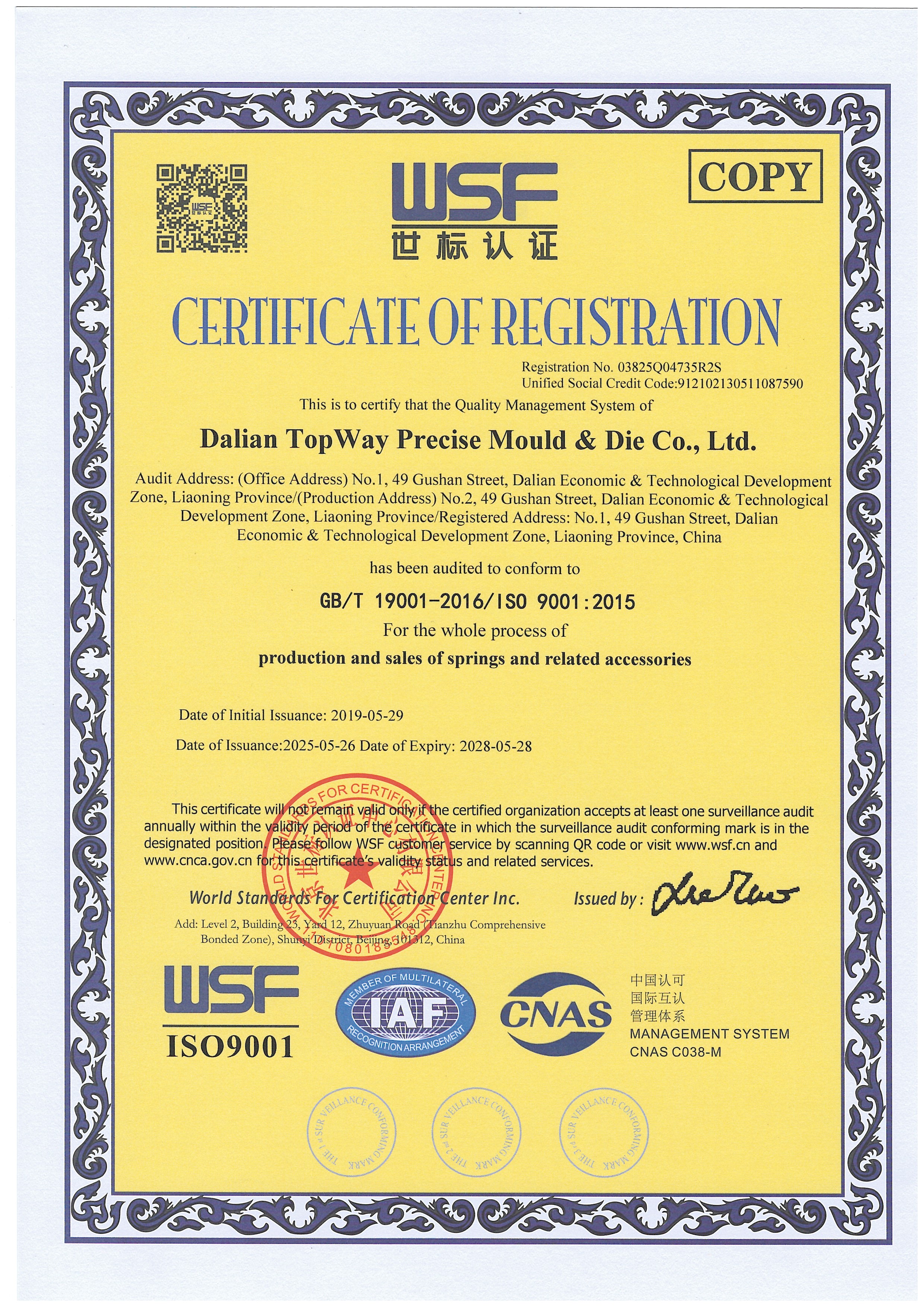
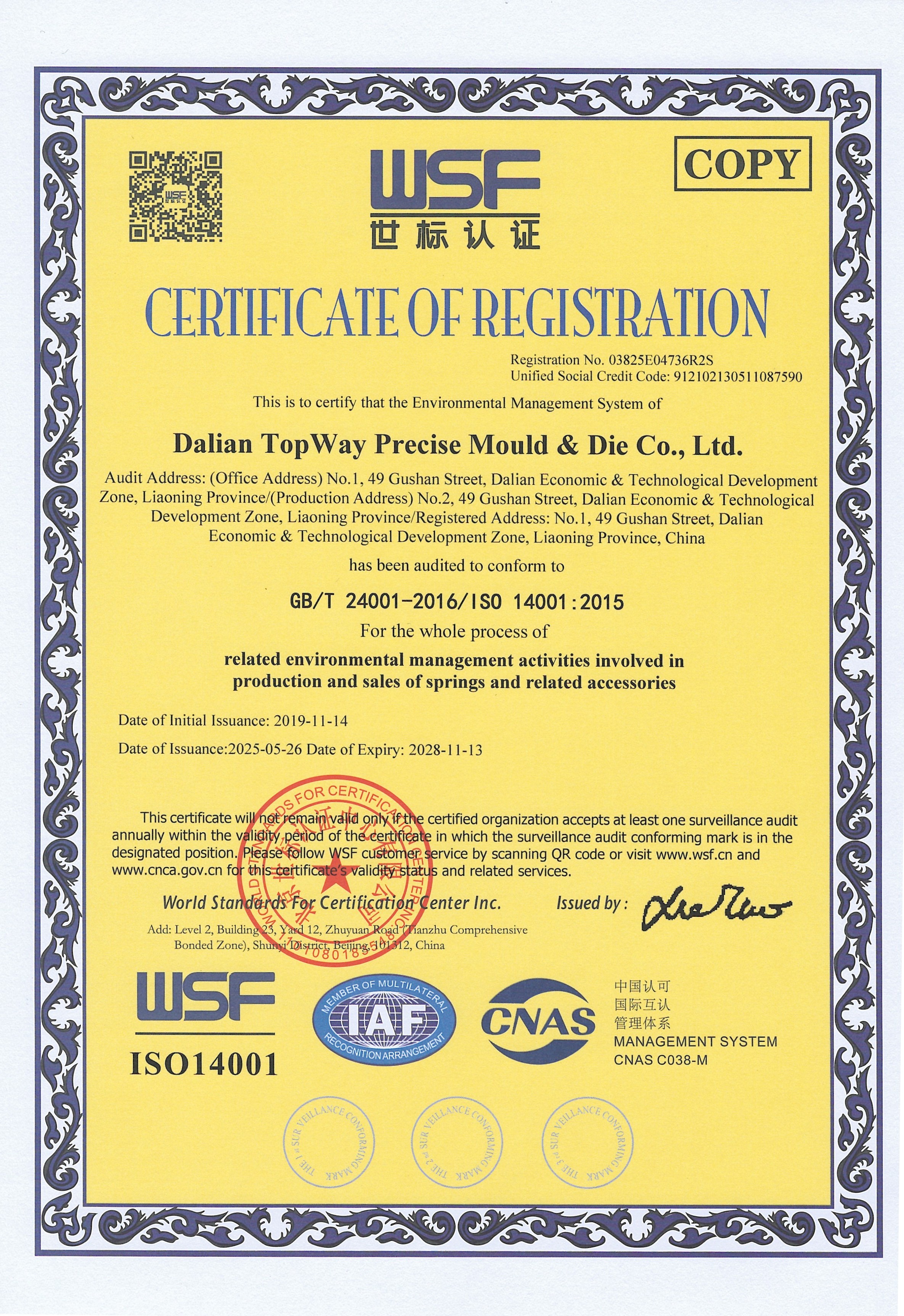
Quality management and environmental management are certified by World Standards For Certification Center Inc. (WSF) to ISO 9001:2015 (certificate 03825Q04735R2S, issued 2025-05-26, valid to 2028-05-28) and ISO 14001:2015 (certificate 03825E04736R2S, issued 2025-05-26, valid to 2028-11-13), with a scope covering the production and sales of springs and related accessories. Both certificates are available for review before an order is placed.
A documented example of this capability is a five-year-plus OEM cooperation with a US-based global mould component brand owner. The programme supplies 1.5 to 2.0 million pieces annually for automotive stamping dies, precision injection moulds and heavy-duty industrial machinery, with third-party laboratory validation of international tolerances, fatigue endurance and thermal relaxation thresholds, a 25% to 30% reduction in the client’s manufacturing and procurement cost, and a 99.8%+ delivery pass rate with zero major quality claims.
Frequently Asked Questions
Do rectangular wire die springs comply with ISO 10243, JIS B5012 and American standards, and can they replace brand-name springs directly?
Yes. Rectangular die springs from TOPWAY SPRINGS are manufactured to ISO 10243, JIS B5012 and American Standard (Inch series) specifications. Because installation dimensions, colour coding and load-deflection characteristics are controlled to those standards, the springs function as direct drop-in replacements without modifying existing mould or die designs. Always name the standard family and class code on the purchase order, since the same colour denotes a different load class in the JIS and ISO systems.
What material supports the higher energy storage, and how long do these springs last?
Rectangular wire springs are made from high-stress oil-tempered alloy steel such as 55CrSi (chrome silicon), chosen for higher tensile strength, better fatigue limits and greater resistance to permanent set and thermal relaxation than plain carbon spring steel. With multi-stage tempering and precision shot-peening, TOPWAY SPRINGS die springs achieve 3 to 5 million high-frequency compression cycles when operated within recommended deflection — a 12% to 40% compression stroke, with roughly 30% to 35% of free length as the long-life target.
What are the commercial terms for a first rectangular wire order?
The minimum order quantity is 100 units per order. Delivery is quoted EXW factory, acceptance is based on third-party inspection (SGS), and payment terms are 30% T/T in advance with 70% T/T before shipment. Monthly capacity of 300,000 pcs supports high-volume programmes, and factory-direct supply has reduced procurement cost by 25% to 30% for an existing OEM partner without changing the specified performance level.
Can custom rectangular coil springs be produced from our drawings or a physical sample?
Yes. Full OEM and ODM production is available, including non-standard outer and inner diameters, non-standard free lengths, specialized trapezoidal wire cross-sections, custom load rates, durable colour-coded powder coatings, laser marking and private branding. Engineering input can start from 2D or 3D drawings, from a physical sample, or from a description of the operating force and stroke in the existing tool. OEM and ODM customization is supported by the 5-engineer R&D team and 300,000 pcs monthly capacity.
What lead time should we plan for, and how do we start the evaluation?
Standard ISO 10243, JIS B5012 and American standard catalog items are held in ready-to-ship inventory and typically dispatch within 24 to 48 hours, which keeps press downtime short when a spring fails mid-production. Custom engineered and bulk OEM orders are typically produced and shipped within 14 to 25 days. To begin, send the pocket dimensions, required force at working stroke, temperature range and preferred standard family — samples or a quotation can then be prepared against the actual tool rather than a catalogue guess. The full product and capability overview is available in the TOPWAY SPRINGS catalogue.
Conclusion: The Decision Rule
Where energy per unit of pocket volume decides the tool design, rectangular wire is the only realistic choice, and the advantage is measurable — approximately 30% to 50% more stored energy than a round wire spring in the same footprint. Where the load is light, the cycle count is low and the pocket is generous, a round wire spring can still be the more economical purchase. The decision rule that survives both cases is to specify by standard family and load class, verify end-face preparation and preload, and validate fatigue behaviour on a sample before committing the die. Buyers who follow that sequence are comparing springs on engineering criteria; buyers who follow colour alone are comparing guesses.
Next step: Request a sample or a quotation for rectangular wire die springs matched to your pocket dimensions and duty class, or download the TOPWAY SPRINGS product catalogue. Technical consultation, custom design and export support are handled directly by the factory.
Dalian TopWay Precise Mould & Die Co., Ltd. (TOPWAY SPRINGS)
Website: www.onetopway.com | Blog: blog.onetopway.com
Address: NO.49-1, GUSHAN STREET, ECONOMIC AND TECHNOLOGICAL DEVELOPMENT ZONE, DALIAN-116610, LIAONING, CHINA
Contact: Liya | Email: liya@chs-spring.com | Tel / WhatsApp: +86 151-4047-4905
Have Questions or Need More Details?
Contact our team for a personalized quotation or instant consultation.
Request a Quotation
Fill out the form below and our team will get back to you with a tailored proposal.
WhatsApp Direct Chat
Prefer to chat in real-time? Message us on WhatsApp for instant assistance & quick answers.
- Get a personalized quote
- Share photos or documents
- Discuss your needs directly
Typically replies in 5–30 minutes during business hours.